From Spreadsheets to 99% Inventory Accuracy: Austin Cutlery & Tool’s ERP Journey
When many business leaders hear “SAP,” they picture sprawling global enterprises, massive IT departments, and Fortune 500 budgets.
But that perception no longer reflects the reality of modern SAP Cloud ERP.
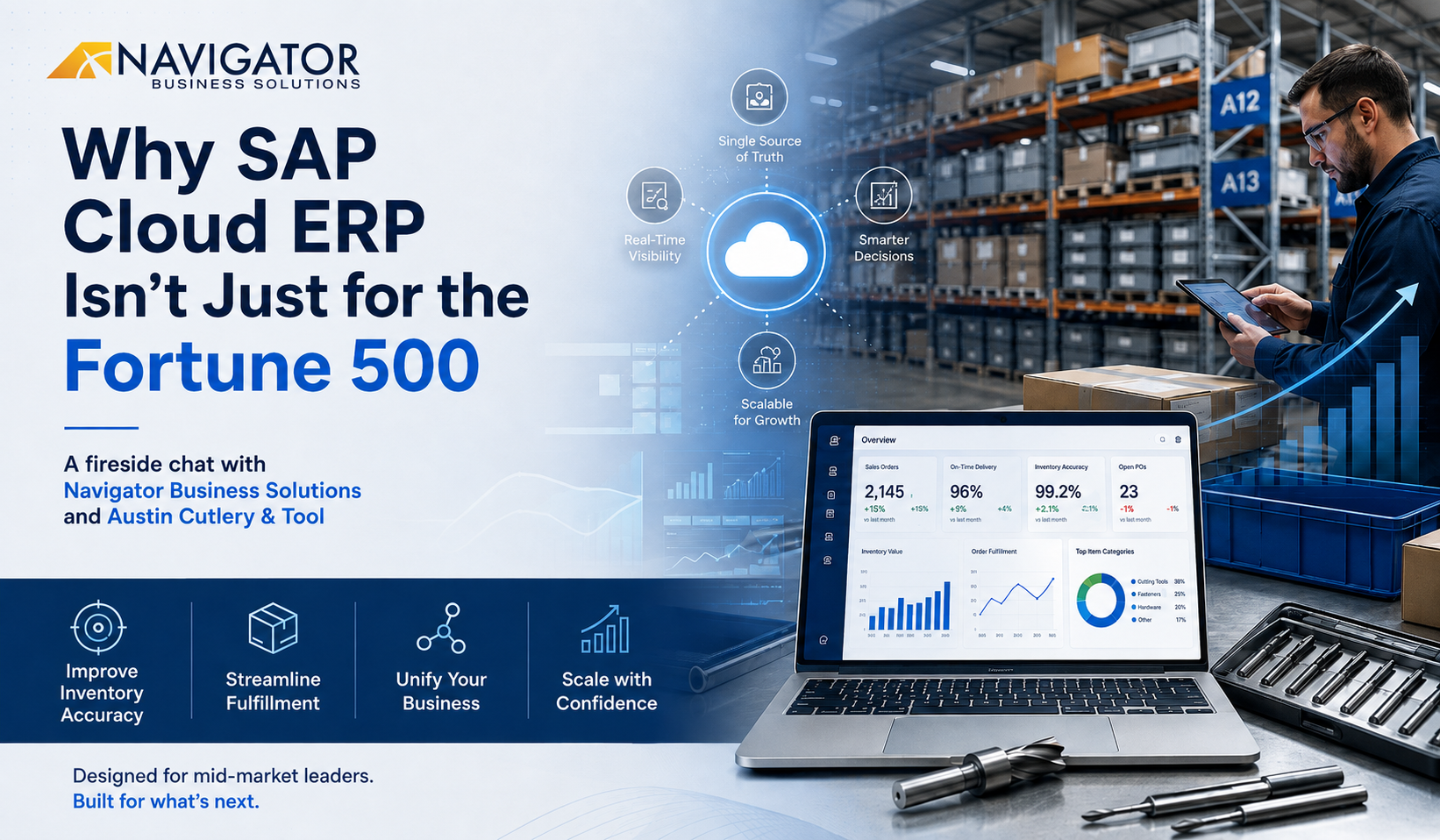
In our recent fireside chat, “Why SAP Cloud ERP Isn’t Just for the Fortune 500,” Navigator Business Solutions sat down with Austin Cutlery & Tool to talk about what ERP transformation actually looks like for a growth-stage company, and why the question businesses should be asking isn’t “Are we big enough for SAP?”
It’s:
“Is our current technology capable of supporting where we want to go?”
That distinction matters. Because for companies experiencing greater operational complexity, disconnected systems and manual processes can become barriers to growth long before they reach enterprise-level headcount.
⬆️ Watch the full fireside chat with Navigator Business Solution and Austin Cutlery and Tool above. ⬆️
Company Size Doesn’t Determine ERP Fit
One of the most persistent misconceptions about SAP is that it is simply too large, complicated, or expensive for small and midsize organizations.
In reality, approximately 80% of SAP customers are small and midsize businesses.
That makes headcount a poor way to determine whether a company is ready for a more sophisticated ERP platform.
A 50-person company with straightforward operations may have very different technology needs than a 50-person organization managing complex inventory, manufacturing processes, multiple revenue streams, or ambitious growth plans.
Instead of asking how many employees an organization has, leaders should consider questions such as:
- How complex are our operations becoming?
- How much manual work is required to keep the business running?
- Can we trust the information coming from our systems?
- How difficult is it to get a consolidated view of the business?
- Will our current technology support the company we expect to become in three, five, or ten years?
For Austin Cutlery & Tool, those questions became increasingly important.
From Disconnected Processes to a Single Source of Truth
Austin Cutlery & Tool had just 47 employees when it began its ERP transformation.
But its operational challenges were anything but simple.
The company was managing disconnected inventory streams, lacked consolidated reporting, and relied heavily on spreadsheets and manual workarounds to bridge gaps between systems and processes.
Those workarounds may keep a business moving temporarily, but they also create risk.
When information lives across multiple systems, spreadsheets, and individual employees, leadership can struggle to answer basic questions with confidence. Inventory becomes harder to track. Reporting takes longer. Employees spend more time reconciling information instead of acting on it.
After implementing SAP Cloud ERP, Austin Cutlery & Tool created what its team described as a single source of truth for the business.
The results were significant.
Inventory accuracy improved from approximately 50–60% to more than 99%. Orders could be fulfilled faster. And instead of manually managing every transaction, employees gained the ability to manage by exception, focusing their attention on the situations that actually required intervention.
That shift represents one of the biggest opportunities ERP transformation can create.
The value isn’t simply replacing one piece of software with another. It’s creating an operating environment where employees spend less time finding, checking, and correcting information and more time making decisions.
Don’t Rebuild Yesterday’s Processes in Tomorrow’s ERP
Technology alone, however, doesn’t create transformation.
One of the most important lessons Austin Cutlery & Tool shared during the webinar was the importance of trusting experienced implementation partners and being willing to adopt best practices.
During an ERP project, it can be tempting to recreate every existing workflow inside the new system.
After all, those are the processes employees already know.
But carrying every legacy process into a new ERP can also mean carrying forward years of inefficiencies.
Instead, Austin Cutlery & Tool embraced the idea of maintaining a clean core and allowed its implementation partner to challenge old ways of working.
That meant asking a different question:
Instead of “How do we make the new system work exactly like the old one?”
Ask “What is the best way to run this process going forward?”
For growing organizations, that mindset can be just as important as the technology itself.
Modern Cloud ERP Lets Businesses Start Simple and Scale
Another outdated assumption about SAP is that implementing it requires turning on an enormous amount of functionality from day one.
Modern SAP Cloud ERP takes a different approach.
Organizations can begin with the capabilities they need today and expand as their requirements evolve. The system is configurable, standardized, and designed to support companies as operational complexity increases.
SAP’s Activate methodology also provides a structured implementation framework designed to move organizations from planning through deployment and adoption.
For Austin Cutlery & Tool, the implementation took approximately 11 months.
And when go-live arrived, the transition wasn’t theoretical.
The team was fulfilling customer orders in the new system the same day.
That kind of outcome requires more than good technology. It requires governance, preparation, executive sponsorship, and organizational commitment throughout the implementation.
ERP Should Be Evaluated as an Investment, Not Just a Cost
ERP conversations often begin with the price of a new system.
But that only tells part of the story.
The more useful comparison is between the investment required for a modern ERP platform and the true cost of maintaining the current environment.
That current cost can include:
- Multiple software platforms and subscriptions
- Integrations that must continually be maintained
- Manual data entry and reconciliation
- Spreadsheet-based processes
- Inventory inaccuracies
- Slow or inconsistent reporting
- Employee time spent compensating for system limitations
- Operational risks created by disconnected data
Those costs don’t always appear neatly on a software invoice, but they have a very real impact on the business.
When evaluating ERP ROI, leadership teams should consider not only what a new system costs, but what their existing ecosystem is costing them in productivity, visibility, scalability, and risk.
Building the Foundation for AI Starts With ERP
The conversation around ERP is also increasingly connected to another executive priority: artificial intelligence.
Companies want to take advantage of AI, automation, and advanced analytics. But those technologies depend on something much more fundamental:
Reliable data.
And reliable data doesn’t come from cleaning up a spreadsheet immediately before feeding it into an AI model.
It comes from consistent business processes running through well-designed applications.
Standardized processes create higher-quality transactional data. Higher-quality data creates a stronger foundation for analytics and AI.
In that sense, ERP modernization isn’t simply about solving today’s operational problems. It can also determine how prepared an organization is to take advantage of tomorrow’s capabilities.
Moving Beyond Your Current ERP? Think Transformation, Not Migration
For organizations already using platforms such as NetSuite, SAP Business One, or other ERP solutions, moving to SAP Cloud ERP shouldn’t be treated as a simple system migration.
It is an opportunity to rethink how the business operates.
Rather than automatically moving existing processes from one platform to another, companies can use the transition to adopt new capabilities, simplify workflows, standardize operations, and eliminate processes that no longer serve the organization.
That mindset becomes especially important for companies preparing for their next phase of growth.
The goal isn’t to recreate the company you have today inside a newer piece of software.
It’s to build the operating foundation for the company you want to become.
The Better Question: Is Your Business Ready for What’s Next?
Austin Cutlery & Tool’s experience challenges the assumption that sophisticated ERP technology is reserved for the world’s largest companies.
With fewer than 50 employees, the organization didn’t choose SAP Cloud ERP because of its headcount.
It chose a platform capable of supporting the complexity of its business and its plans for the future.
That may be the most important takeaway for other growth-stage companies considering ERP.
Don’t choose technology based solely on the size of your business today. Choose it based on the business you’re building for tomorrow.
If disconnected systems, manual workarounds, unreliable data, or limited visibility are beginning to constrain your organization, it may be time to reconsider what an ERP designed for growth can look like.
Watch the full fireside chat, “Why SAP Cloud ERP Isn’t Just for the Fortune 500,” above to hear directly from Navigator Business Solutions and Austin Cutlery & Tool about the implementation journey, lessons learned, and results of moving to SAP Cloud ERP.
www.nbs-us.com | info@nbs-us.com | (801) 642-0123 | Contact Us Form