Beyond SAP Business ByDesign: Planning the Next Stage of ERP Growth
SAP Business ByDesign has enabled many mid-market organizations to modernize their operations by adopting a cloud-based, integrated ERP platform. The system brings together finance, supply chain, procurement, and customer management within a unified environment, providing operational discipline and visibility for growing companies.
However, as organizations scale, expanding product portfolios, global operations, data volumes, and digital channels, the demands placed on the ERP platform increase significantly. Leadership teams often reach a point where they must reassess whether their existing ERP architecture is aligned with the company’s next phase of growth.
SAP’s cloud ERP strategy has evolved considerably over the past decade. Today, SAP Cloud ERP (SAP S/4HANA Cloud Public Edition) represents SAP’s primary platform for organizations seeking advanced scalability, real-time analytics, and deeper enterprise capabilities.
For companies currently running SAP Business ByDesign, the question is rarely whether the platform still works. Instead, the more strategic question is:
Is the current ERP system positioned to support the organization’s next five to ten years of growth and digital innovation?
The ERP Evolution for ByDesign Customers
Most organizations running SAP Business ByDesign follow a predictable technology trajectory as their businesses scale. This progression can be understood through an ERP growth curve consisting of four phases.
Phase 1 - Cloud ERP Foundation
Organizations adopt SAP Business ByDesign to replace fragmented systems and establish integrated business processes.
Typical priorities include:
- financial visibility and governance
- integrated supply chain operations
- standardized procurement processes
- unified reporting and analytics
At this stage, SAP Business ByDesign provides a strong operational backbone.
Phase 2 - Growth and Operational Expansion
As companies scale, operational complexity increases.
Organizations may expand through:
- international market expansion
- acquisitions or multi-entity operations
- digital commerce and omnichannel distribution
- larger supplier and logistics ecosystems
SAP Business ByDesign can support these developments for many organizations, particularly those operating within the traditional mid-market scope.
Phase 3 - Operational Complexity and Strategic Questions
As scale continues to increase, leadership teams may encounter structural limitations in their ERP environment. These challenges often manifest in areas such as:
- advanced manufacturing or supply chain requirements
- deeper financial consolidation across entities
- increasing integration demands across digital platforms
- Greater expectations for real-time enterprise analytics
- More complex Manufacturing and preventative maintenance planning
At this stage, ERP discussions often shift from operational support toward long-term scalability.
Phase 4 - Enterprise-Ready Cloud ERP
Organizations seeking greater operational scale and advanced enterprise capabilities often evaluate SAP Cloud ERP (S/4HANA Cloud Public Edition) as the next step in their ERP evolution.
This platform introduces a new architecture built around real-time data processing, embedded analytics, and extensibility through the SAP Business Technology Platform.
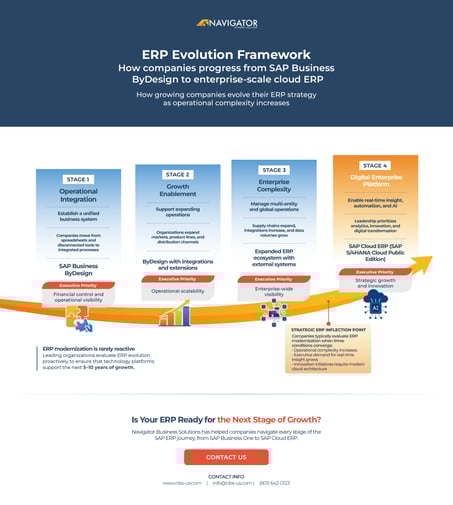
Download the ERP Evolution Framework Infographic
Signals It May Be Time to Evaluate ERP Evolution
Companies rarely replace ERP systems simply because of age. Instead, the decision typically emerges when business complexity outpaces the architecture of the existing platform.
Five signals frequently indicate that an organization may be approaching this inflection point.
1. Operational Complexity Outpaces System Design
As companies expand into global markets, multi-entity structures, and sophisticated supply chains, the ERP system must support increasingly complex operational models.
2. Executive Demand for Real-Time and AI-driven Insight Increases
Leadership teams increasingly expect immediate access to operational and financial data. Modern ERP platforms provide embedded analytics and predictive capabilities that support faster decision-making.
3. Integration Ecosystems Expand
Modern organizations operate within highly connected digital ecosystems that include e-commerce platforms, logistics providers, and customer engagement systems. Managing these integrations efficiently becomes a strategic priority.
4. Innovation Becomes a Strategic Priority
Artificial intelligence, automation, and advanced analytics are becoming central to enterprise transformation. These capabilities increasingly depend on modern ERP architecture and well-structured data.
5. Long-Term Technology Roadmap Alignment
Organizations planning their technology strategy over a five-to-ten-year horizon often reassess whether their current ERP system aligns with SAP’s innovation roadmap and the company’s long-term growth ambitions.
Why SAP Cloud ERP
SAP Cloud ERP represents SAP’s next-generation cloud ERP architecture. It combines enterprise-grade functionality with the flexibility and continuous innovation of a modern cloud platform.
Key advantages include:
-
Real-time analytics and reporting
-
SAP’s in-memory architecture allows operational and financial data to be analyzed instantly, enabling faster executive decision-making.
-
-
Integrated enterprise processes
-
Finance, supply chain, manufacturing, procurement, and analytics operate within a unified digital core, reducing system fragmentation.
-
-
Extensibility through the SAP Business Technology Platform
-
Organizations can integrate external systems, extend applications, and adopt new innovations without modifying the core ERP system.
-
-
Embedded AI and automation
-
SAP is increasingly delivering artificial intelligence capabilities directly within the S/4HANA Cloud ecosystem, enabling predictive insights and automated workflows.
-
Planning the Transition
Moving from SAP Business ByDesign to SAP Cloud ERP should be approached as a strategic transformation rather than a technology replacement.
Leading organizations typically evaluate the transition through three lenses:
-
Operational scalability - Can the ERP platform support the organization’s expected growth trajectory?
-
Digital innovation readiness - Is the system architecture aligned with future technologies such as AI, advanced analytics, and automation?
-
Long-term technology strategy - Does the ERP roadmap align with the company’s broader digital transformation strategy?
Key Takeaways
SAP Business ByDesign remains a capable cloud ERP platform for many mid-market companies.
However, as organizations scale, the ERP conversation often evolves from operational efficiency toward enterprise readiness and long-term innovation.
For companies already operating within the SAP ecosystem, SAP Cloud ERP provides a natural path forward, preserving SAP’s integrated business processes while enabling the scale, analytics, and innovation required for the next stage of growth.
The critical question for leadership teams is not whether the current system still functions.
The more strategic question is: Is the ERP platform prepared to support the company’s next decade of growth?