What Every Executive Needs to Know Before Transforming Their Business
Digital transformation isn’t just a buzzword anymore; it’s become the backbone of how modern organizations scale, compete, and future-proof their operations. Yet for many executives, the journey begins with a familiar pain: outdated systems, inefficient processes, and technology that simply can’t keep up with where the business needs to go.
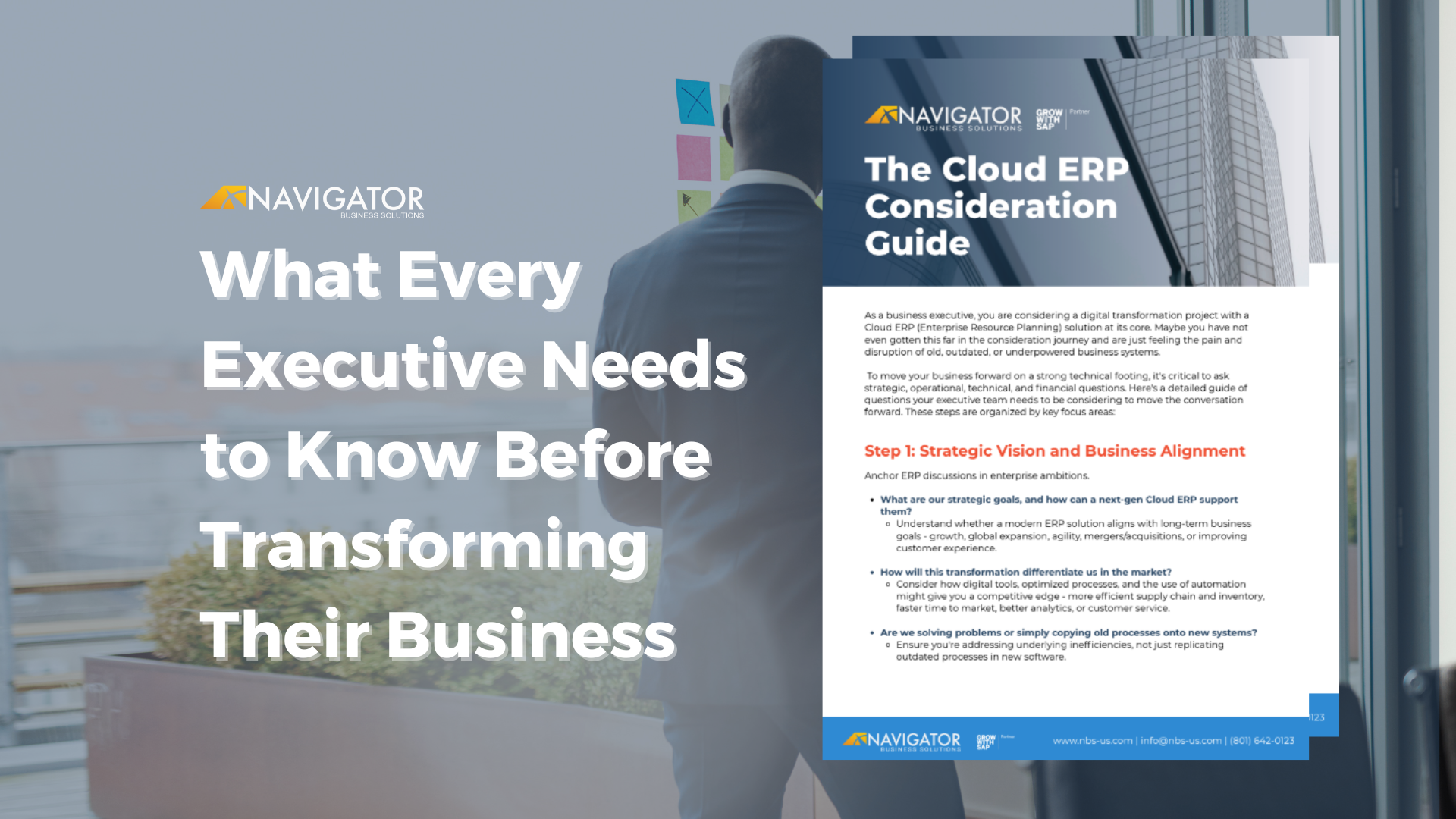
The Cloud ERP Consideration Guide distills this complex journey into seven clear steps, each designed to help leaders evaluate readiness, ask the right questions, and ensure their ERP decision drives real, measurable value.
Below is a high-level preview, but the full guide digs deeper into the strategic questions you must ask before you take your next step.
- Start with Strategic Alignment: As highlighted on page 1, the guide begins with foundational questions:
What are your long-term goals, and how can a next-generation Cloud ERP support them?
Executives are urged to anchor every ERP discussion in business outcomes, whether that’s growth, global expansion, mergers, or leveling up customer experiences. The visual on page 1 emphasizes this alignment by positioning ERP as an enabler, not just a system replacement. - Assess Operational Readiness: ERP is as much about people and processes as it is about software.
The guide challenges companies to evaluate whether their processes are standardized or heavily customized, whether they have true internal champions of change, and whether their culture is prepared for digital adoption. The insights on page 2 make it clear: technology won’t save a team that isn’t ready for transformation. - Evaluate Cloud ERP Options Thoughtfully: Not all cloud models are created equal. From public to private to hybrid clouds, each model offers trade-offs in scalability, cost, and control. Page 2 includes screenshots of modern SAP Cloud ERP dashboards, a visual reminder that industry-specific capabilities can reduce customization, speed deployments, and simplify operations.
- Prioritize Security, Compliance & Risk: As detailed on page 3, digital trust is non-negotiable. Executives are encouraged to dig into data security, privacy standards, uptime guarantees, disaster recovery strategies, and data ownership. These are not minor details. They are deal-breakers.
- Understand the Full Financial Picture: Costs go well beyond licensing. The guide emphasizes Total Cost of Ownership (TCO), including implementation, training, support, upgrades, and savings from reduced infrastructure and maintenance. It also highlights realistic approaches to ROI and how innovations like AI and automation impact long-term value.
- Prepare for Implementation & Change Management: On page 4, the guide makes it clear: even the best ERP can fail without proper execution. Executives must understand timelines, resource demands, integration challenges, and support expectations. Visuals in this section underscore the complexity of integrating with systems like MES, PLM, EDI, Amazon, and Shopify.
- Future-Proof Your Roadmap: Transformation isn’t a one-and-done milestone. The final step encourages businesses to consider how the ERP will evolve with emerging technologies - AI, automation, IoT; and how often the organization plans to revisit its digital roadmap to ensure continuous improvement.
About Navigator Business Solutions
Navigator Business Solutions has proven experience guiding 300+ organizations through ERP transformation, leveraging SAP Cloud ERP and fit-to-standard best practices to reduce risk and accelerate value
Ready to Transform, But Not Sure Where to Begin?
The guide gives executives a structured way to evaluate strategy, readiness, risk, cost, and future direction — but there is one critical question that ultimately determines the success or failure of any ERP transformation.
It’s the question that even seasoned executives often overlook…
And it’s the one question the full guide reveals, along with how to answer it.
👉 Download the complete Cloud ERP Consideration Guide to uncover the final question that could make or break your ERP journey.